
Erie County Projected Release Dates
A projected date is a calculation or scheduled endpoint. An actual release date records when custody changed. The two can match, but they answer different questions. A jail or prison may show a date before staff complete final checks. A warrant, detainer, transfer order, or amended court entry can prevent a release to the street. The later release sheet or ODRC detail is the stronger source for what truly occurred.
Pretrial custody works differently. Someone held in the Erie County Jail while a case is pending does not have a sentence endpoint. Bond may be posted, the court may order recognizance release, a charge may be resolved, or another agency may assume custody. A future date appearing on the roster can be planning data, not proof of departure. The court docket and jail record must be read together.
For sentenced people, first decide whether the term is in county jail or an Ohio prison. The Erie County Sheriff applies the local commitment document, jail credit, and its release procedure. ODRC applies Ohio sentencing statutes, sentence-specific earned credit, and any parole or indefinite-sentence framework. One system should not be used to guess the other system's date.
Find an Erie County Release Date
The search begins with custody type. The ODRC offender search is useful only when a person entered the state prison system or state supervision. A short Erie County Jail sentence may never appear there. Conversely, the local roster cannot calculate the prison term of someone conveyed to ODRC.
- Identify whether the person is pretrial, serving an Erie County jail commitment, or serving an ODRC prison sentence.
- For jail custody, read the roster's Court field and note the booking date, Jail ID, disposition, and any displayed Release Date.
- Open the correct local court docket and find the commitment, sentencing entry, jail-time credit, bond entry, or later order.
- Ask the Erie County Jail Division for the booking/release sheet when the online roster does not establish the actual timestamp.
- For a state prisoner, search ODRC by name or offender number, open the matching detail, and read the Expected Release Date/Parole Eligibility Date and release detail.
- Compare any parole hearing, APA supervision, hold, and sentence information before treating the date as final.
The ODRC offender search form shows the Ohio status and search fields used in a state release-date lookup.
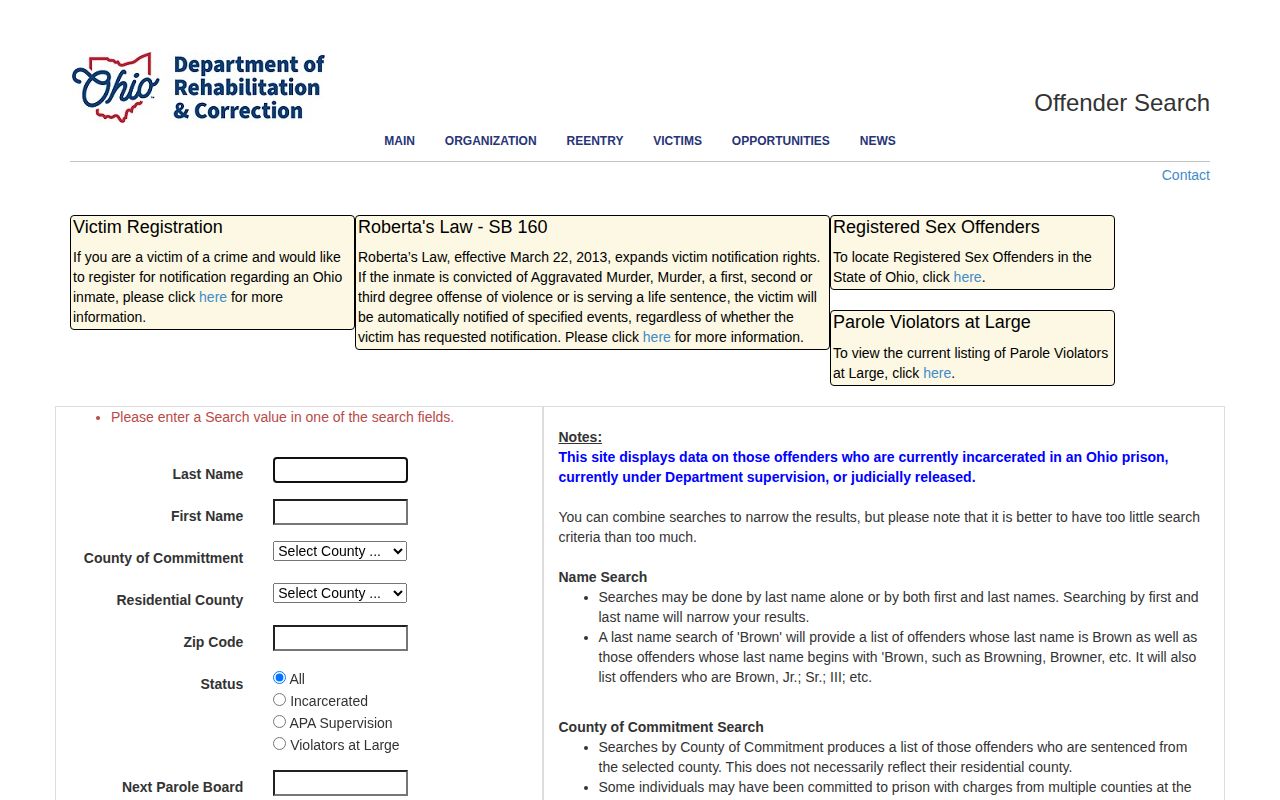
The form can narrow by name, offender number, county of commitment, residential county, ZIP, status, or hearing month. Erie as county of commitment refers to the recorded sentencing county and may not equal the person's current residence.
The broader record-request and custody search sequence is available on the Erie County released inmates home page.
ODRC Erie County Release Labels
ODRC combines two concepts under the label “Expected Release Date/Parole Eligibility Date.” Its definitions describe that field as the Projected Release Date or a date pending parole consideration. The detail page must be read to tell which meaning applies. A parole eligibility date gives an opportunity for Board review. It is not an automatic release appointment.
| ODRC label | Meaning |
|---|---|
| PRD | Projected Release Date under the sentence calculation. |
| POA | Parole on or after, the earliest date for release to APA supervision in the applicable record. |
| Parole eligibility | A date for possible consideration under the sentence, not a promise of release. |
| APA Supervision | A community supervision status that may follow release from state custody. |
| Supervision end | The displayed endpoint for an APA term, subject to official updates. |
| TC/TT Sentence Expiration | A projected endpoint tied to Transitional Control or a halfway-house setting. |
The ODRC definitions page explains the release and status labels used in offender details.
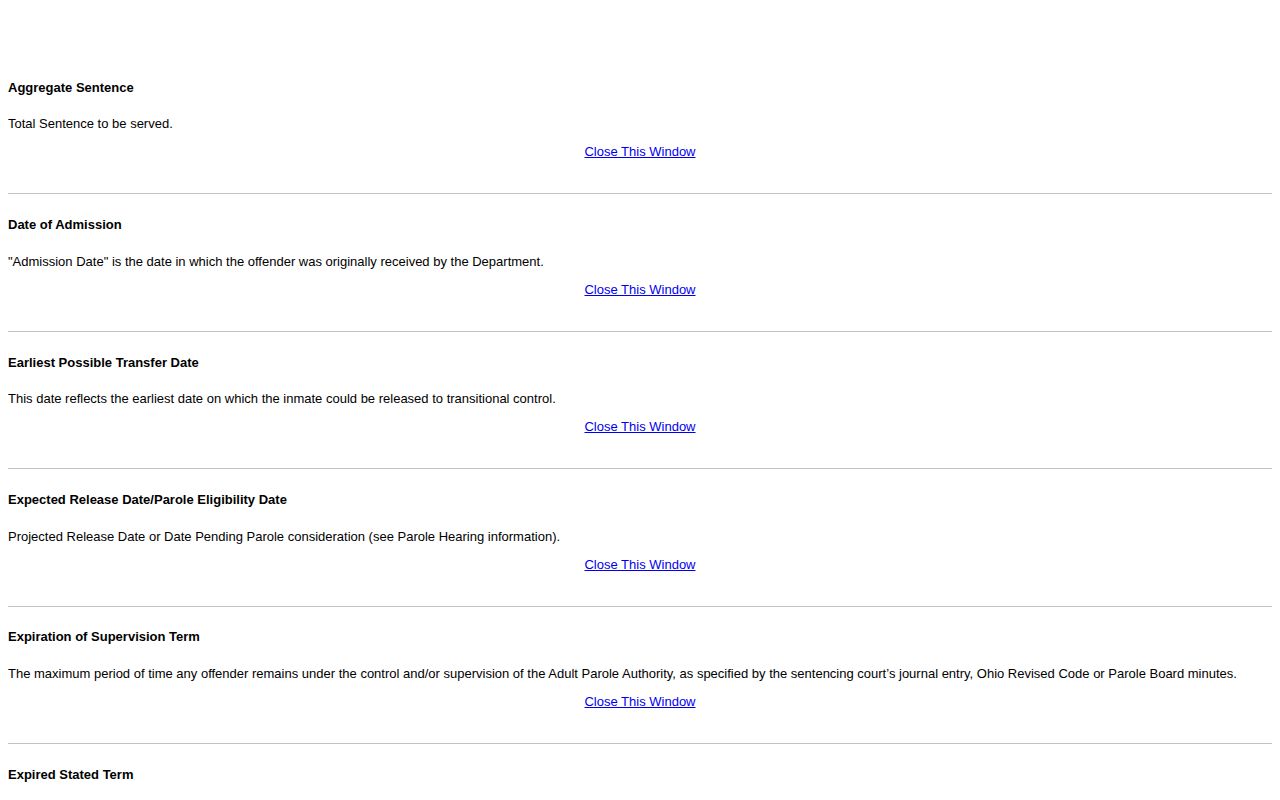
Those definitions keep PRD, POA, hearing dates, and supervision dates from being collapsed into one supposed day of freedom.
Note: A future Parole Board month shows review timing, while a later decision and release detail show whether parole was granted and carried out.
Erie County Jail Timing Rules
Erie County publishes a specific commitment-release rule. When the authorizing document gives no time, a jail commitment ends with release at 5:00 a.m. on the scheduled date. For a three-day OVI commitment, the jail counts 72 actual hours from booking. Three calendar labels are not enough. The book-in timestamp controls that local calculation.
This rule has limits. A court can specify a different time. Jail staff must also check holds, warrants, new court orders, and transfer directions. A person whose local term ends may be released to another agency rather than to the community. The jail's documentation should distinguish physical release from agency transfer and show the actual date and time.
Bond does not create a sentence-based projected date. It permits release on the pending case once the required process is complete, subject to any other hold. A recognizance order works through the court as well. If a person remains on the roster after bond action, check for processing lag, another charge, or a separate agency warrant instead of adding hours to a supposed release formula.
The Erie County commitment release-time policy is the direct source for the local timing rule, not a 72-hour released-person list. A request to Jail Division should name the person, approximate booking date, Jail ID or case number when known, and the requested release timestamp, authority, and destination. The court journal then shows why the term or order applied.
Ohio Earned Credit Calculations
Ohio does not have a universal rule that every state prisoner serves 85 percent. That shorthand comes from a different framework and should not be applied to an Erie County sentence. Definite and indefinite terms, mandatory time, jail-time credit, earned credit, disciplinary losses, consecutive or concurrent sentences, judicial release, parole review, and post-release control can affect the dates. The sentencing journal and ODRC detail must be reviewed together.
For confinement on and after April 4, 2024, current earned credit is principally governed by ORC 2967.194. Eligible participants may provisionally earn one or five days for each completed month of qualifying productive activity. A second qualifying program or activity can add up to five days. Certain program completions can yield 90 days or ten percent of the stated term, whichever is less, per completion. The ordinary aggregate cap is 15 percent, with the specified completion credit treated separately by the statute.
Eligibility is offense and sentence specific. Nonreducible terms, aggravated murder or murder and related liability, life without parole, certain ORC 2971.03 terms, and specified sexually oriented offenses are among the exclusions or special categories. Older qualifying confinement before the effective date may involve former ORC 2967.193. A sentence crossing that boundary can require both rules. Do not calculate a release date from a simple percent without the official sentence record.
Jail-time credit is another separate input. It accounts for qualifying confinement credited by the court and is not the same as earned credit for program participation. If the number of credited days is corrected, ODRC may revise the projection even though the sentence length itself did not change. The amended journal entry and updated offender detail provide the traceable explanation.
Erie County Indefinite Sentences
Ohio's Reagan Tokes Law indefinite sentences use a minimum term and a rebuttable-presumption release framework under ORC 2967.271. The minimum date does not erase the sentence's maximum component. ODRC and the governing process may address continued confinement under the statute. Older indefinite sentences may instead rely on parole eligibility rules in ORC 2967.13.
Parole eligibility is equally specific. Some life terms have minimum points set by statute, while life without parole and other excluded sentences have no parole eligibility. Consecutive terms, mandatory portions, and the offense category change the calculation. A monthly Parole Board hearing date only shows when review is scheduled. It does not prove release at the first eligible moment.
Judicial release is different again. Under ORC 2929.20, the sentencing court may consider a qualifying motion through its own process. A court grant is not the same as a Parole Board grant. Confirm it in the Erie County Common Pleas journal and then check ODRC release detail for the actual custody change.
Why Erie County Release Dates Change
A date can move for legal, administrative, or custody reasons. Some changes correct the sentence calculation. Others reflect new authority that prevents a street release. The official record should identify the factor rather than invite a guess based on a missed date.
| Factor | Possible effect |
|---|---|
| Corrected jail-time credit | Moves the calculated endpoint when credited days are amended. |
| Amended entry or resentencing | Changes the controlling sentence after court action. |
| Earned-credit award or loss | Adjusts an eligible ODRC projection under the applicable statute. |
| Parole grant, denial, or continuance | Changes whether and when an eligible person may leave for APA supervision. |
| Detainer or warrant | Can cause continued custody or transfer after one term ends. |
| New conviction or consecutive term | Adds or rearranges time that must be served. |
| Calculation correction | Fixes data or application errors in the sentence record. |
The Erie County jail manual requires hold and warrant checks before release. Therefore, an expired local commitment may lead to an agency handoff. For ODRC, a public example detail shows how status, release, and supervision fields appear together.
The ODRC released and APA example record illustrates that multi-field view.
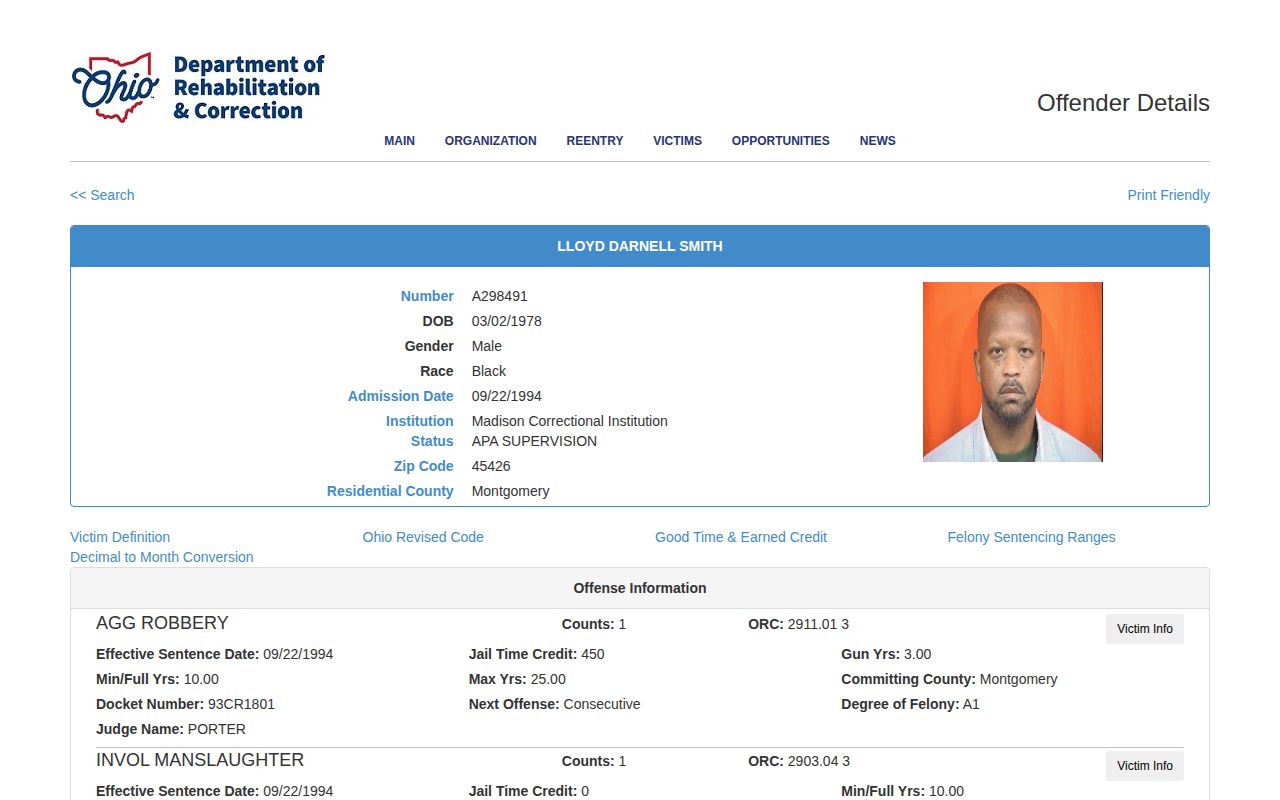
The example is evidence of the portal layout, not a substitute for searching and matching the person at issue.
Confirm Erie County Actual Release
For a county-jail sentence, the Sheriff's booking/release sheet is the direct record of the actual timestamp and destination. Ask for the public portions showing booking date and time, release date and time, authority, disposition or destination, and charge or court linkage. The Sheriff's policy allows a mixed record to be redacted so public portions can still be released. It does not promise a fixed response period.
For an Ohio prison sentence, review the ODRC detail after the projected date. Compare status, release detail, release type, and any APA supervision dates with the Common Pleas sentencing journal. If a parole decision applies, distinguish grant from physical exit. A grant authorizes release subject to the decision and processing, while a denial or continuance does not. For a county-only case, the Sheriff-linked current roster is only a starting snapshot, never the historical proof.
A future-event alert can supplement those records. The Erie County VINE Inmate Check explains how to register against the correct record. VINE is useful for notice, but it does not replace the final jail, court, or ODRC documentation.
Note: Recheck the originating record after the scheduled date because a projection may change without proving an error in the earlier display.