
Erie Released Mugshots Are Records
A mugshot, also called a booking photograph, is an identification image made during admission to custody. Erie County’s jail policy requires each admitted person to be identified by photograph. The Sheriff-linked roster embeds that image in an active custody row. Release changes the person’s custody status, but it does not erase the fact that the agency made a booking record.
Public access is record-specific. Ohio Revised Code 149.43 supplies the public-records framework, subject to exceptions and other laws. Juvenile material, sealed records, protected personal data, security information, and some court-directed restrictions can limit disclosure. Ask for the segregable public parts of a named booking record and accept lawful redactions. A photograph should not be treated as proof of conviction, release reason, or present custody.
Find Erie County Released Mugshots
The strongest photo channel depends on where the person was held. The Erie roster can show the local booking image while its row remains online. The Sheriff’s retained file is the best historical route after that row disappears. ODRC may show a different institutional photograph for a person who later entered Ohio prison. A registry photo reflects a continuing registration duty and is not a release-list image.
| Channel | Has a photo? | How to access it |
|---|---|---|
| Erie New Inmate Roster | Yes, on displayed rows | Open the Sheriff-linked current roster; it is not a historical gallery. |
| Sheriff records request | The file may contain it | Request the booking photograph by name, booking date, and Jail ID or case number. |
| ODRC Offender Search | Often on an offender detail | Use only for an Ohio prison or state-supervision record, not a county-only stay. |
| Erie offender registry | May show a registration image | Use only when a continuing statutory registration duty is relevant. |
| Ohio VINELink | Varies by participating record | Use for custody status and notification, not as the official photo archive. |
| News or commercial copies | Sometimes | Treat as secondary, possibly stale context and return to the official record. |
A photo match should use more than appearance. Compare the person’s name, Jail ID or offender number, booking date, court, and case. Similar names and old images can create mistakes. The image does not establish what occurred after booking.
Erie Roster Photos Can Disappear
The JDS New Inmate Roster is Erie County’s strongest official-linked web photo channel. It places the booking image beside Jail ID, name, charges, court, disposition, bail, SID, book date, attorney, next court date, arresting agency, and Release Date. Yet the report is a current roster. It has no released-person archive and no selectable photo history.
Once a row leaves the report, the image may no longer be available at that URL. That web change is not proof that the agency destroyed its booking file. The Sheriff maintains records under an approved retention schedule. A requester should identify the booking or photograph series, the approximate date, and the person or Jail ID. If the image is unavailable, ask whether it was withheld, never existed in the requested form, or was destroyed under a cited schedule.
The roster’s Release Date field does not make it a 24-hour photo feed. For the same-day custody workflow, see the 24-Hour Releases page. It explains how to confirm the event without relabeling a current roster.
Why Erie Booking Photos Exist
Erie’s 2026 jail manual documents the local photo practice. Every admitted inmate is identified by photograph as part of booking. The same manual requires identification before release, use of release documentation and checklists, checks for holds and warrants, and a distinction between leaving custody and being released to another agency. The image and release sheet are therefore connected to the same custody episode but prove different points.
This distinction matters after the roster changes. The photograph helps identify which booking record is at issue. The release entry provides the actual time, authority, and destination. A targeted request for both items is more reliable than a copied image with no custody context. Ask for the booking photograph separately so the Sheriff can make a record-specific disclosure and retention decision.
- Booking photograph
- The identification image made when the person enters the Erie jail process.
- Jail ID
- The local identifier that ties the photo to the correct custody record.
- Release authority
- The order, sentence rule, bond, or other basis for the custody change.
- Release disposition
- The destination, which can be the community or another agency.
Request Erie Released Booking Photos
Send a narrow request to Sheriff Paul Sigsworth’s Erie County Sheriff’s Office at 2800 Columbus Avenue, Sandusky, OH 44870. The main number is 419-625-7951, and the Jail Division is 419-627-7569. State that an electronic copy is preferred. Ask for advance notice of any permitted media, postage, or special-material cost. The Sheriff’s policy says ordinary records have no fee except where otherwise noted, with video handled separately, so court copy fees should not be applied to a jail photo request.
- Identify the person by full name and approximate booking date. Add the Jail ID or court case number if known.
- Request the booking photograph from that specific Erie County Jail admission.
- Request the public booking and release sheet, including booking time, release time, authority, and destination.
- Ask for electronic delivery and a fee estimate before any charge is incurred.
- Invite redaction of exempt fields and ask for the legal basis if the photograph or another part is denied.
- If the file no longer exists, request the applicable retention-schedule citation.
The office need not create a new record or restore an old roster page. It can disclose existing public material in the form it keeps. Avoid requesting medical intake details, Social Security numbers, emergency contacts, or security data. Those fields do not help identify a public booking photograph.
Erie Released Photos Beyond Jail
A person later committed to state prison may have an institutional image on the ODRC Offender Search. Select Released or APA Supervision when the record supports state custody or supervision. Compare the offender number, conviction court, and status fields. An ODRC photograph belongs to the state correctional record and may not be the same image taken by Erie County Jail.
The Erie County offender registry is another limited channel. It can display a current registration photograph for a person who has a continuing statutory duty. That image is not a county release archive, and absence from the registry says nothing about whether an ordinary former detainee remains confined. Use registry information only for the legal purpose and scope the official source assigns to it.
Ohio VINE serves custody status and notifications from participating systems. It may display identifying material, but its main value is the event record. A Released result can support a status change reported by an agency. The Sheriff release sheet or ODRC detail supplies stronger historical context.
Erie Sheriff App Photo Limit
An official iOS app called Erie County Sheriff, OH exists. Its public description identifies tips, news, and alerts. Research did not verify an inmate-search, recent-release, or mugshot feature. Official ownership alone does not establish that the app displays booking photos. The live roster and a targeted Sheriff request remain the documented local channels.
The official app listing shows the public feature description.
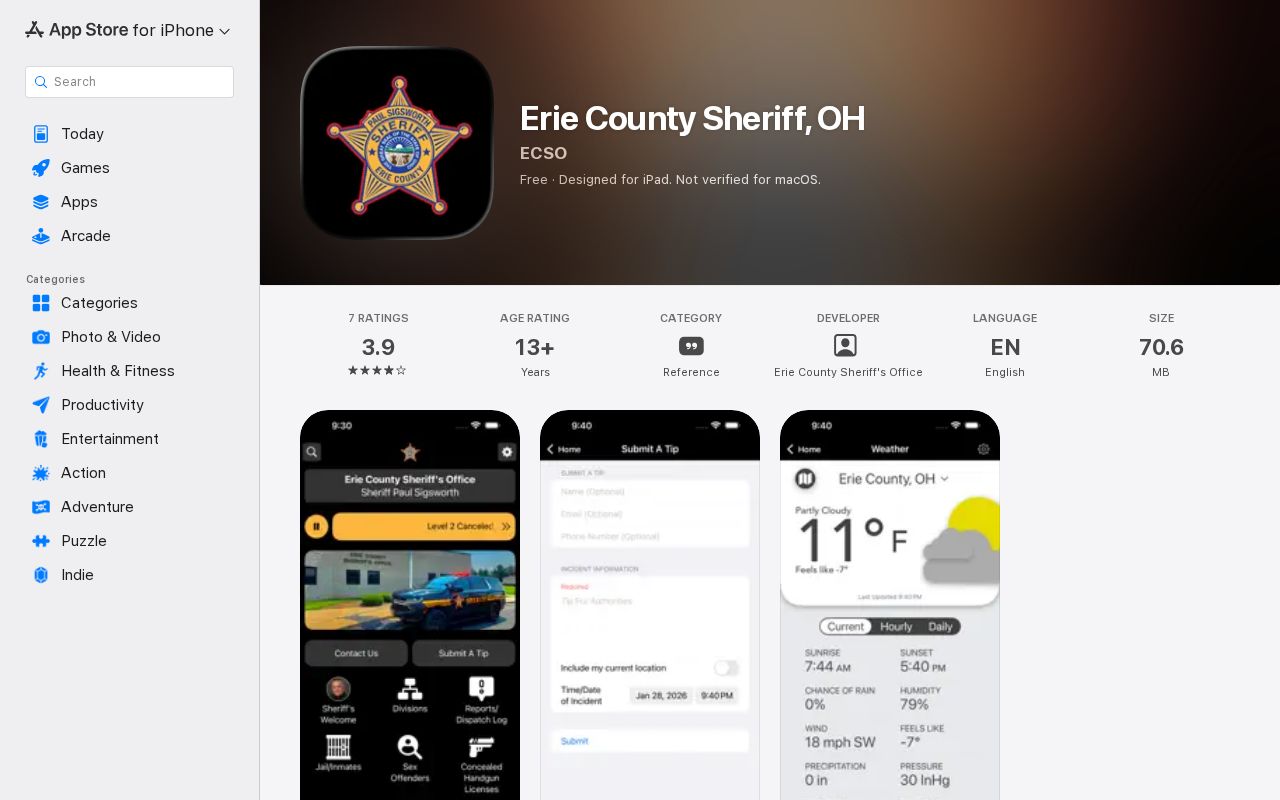
The listing supports use of the app for Sheriff communications, not as a promised Erie County mugshot gallery or release feed.
Social posts and news reports can also preserve an arrest image. They are secondary sources. A report about an arrest does not prove that the person was later released, and an old photograph does not establish current identity or status. Verify both the booking and the later custody change through official records.
Erie Mugshots After Record Sealing
Ohio sealing and expungement rules appear in ORC Chapter 2953, including ORC 2953.32, 2953.33, and 2953.34. Eligibility and effect depend on the case and current law. A sealed court matter may disappear from ordinary public access while restricted agency records remain. Do not use cached copies to reconstruct information that an official source no longer makes public.
Ohio also addresses payment demands tied to criminal-record images. ORC 2927.22 prohibits the specified solicitation or acceptance of payment to remove, correct, modify, or withhold criminal-record information that includes a booking photograph. It provides criminal and civil consequences. The statute does not require a sheriff to maintain a public photo gallery, and it does not make every photo disclosable despite another valid restriction.
If an official image seems tied to the wrong person or booking, send a precise correction request to the office that controls it. Include the Jail ID, booking date, and the court entry that supports the correction. For a sealing question, use the court and qualified legal help. Do not pay a commercial publisher on the assumption that payment changes the official Erie County record.
Verify Erie Photo and Release
A reliable result uses two records. First, tie the image to the exact booking through the Jail ID, booking date, charge, court, or case number. Second, tie the custody change to a release sheet, court journal entry, or ODRC record. The photo alone cannot show whether the person bonded out, completed a sentence, transferred, remained held for another agency, or entered supervision.
| Question | Best Erie or Ohio source |
|---|---|
| Is this the Erie booking image? | Sheriff roster or the requested booking photograph linked by Jail ID. |
| When did county custody change? | Sheriff release sheet with date, time, authority, and destination. |
| What court action led to release? | The chronological docket and journal entry from the named court. |
| Did the person enter Ohio prison? | ODRC offender detail plus the Common Pleas sentencing entry. |
| Is the record sealed? | The court that issued the order, applying current Ohio law. |
The full Erie County released-inmate search and release-record process is on the home page. It explains why roster disappearance is only a clue and how county, state, and federal systems differ.