
Erie County Jail Release Paths
An Erie County Jail release can end local custody in two very different ways. A physical release may return a person to the community after bond, a court order, dismissal, completion of a jail commitment, or another lawful instruction. A release to another agency is a transfer. In that event, the person can leave the Erie County Jail while another county, the Ohio Department of Rehabilitation and Correction, the U.S. Marshals Service, or another authority takes custody. The local roster may no longer show the person in either case.
The key record is the Jail Division's booking and release documentation. It should identify the time custody changed, the legal authority, and the release disposition or destination. The related court docket supplies the order, bond action, dismissal, sentence entry, or transport direction behind the change. The Erie County released-inmate search and records overview explains how these county, court, state, and federal paths fit together.
Confirm an Erie Jail Release
The Sheriff-linked New Inmate Roster is a current-custody snapshot. It has a report run time and a Release Date field, but Erie County does not label it as a released-person archive. A blank release field on a displayed row supports only that the report shows no release date for that active entry. If a name is missing later, the person could have gone home, moved to another jail, entered state custody, or remained held for another authority.
- Check the roster and record its run time. Use the Jail ID, court, book date, and arresting agency to avoid a same-name error.
- Open the docket for the court shown on the roster. Look for a bond entry, release order, sentence completion, dismissal, probation terms, or transport order.
- Ask the Erie County Sheriff for the booking/release or incarceration record. Request the actual release time, authority, disposition, and destination.
- If the record shows prison conveyance, use the ODRC Offender Search. Select the status that fits and compare the state record with the Erie County court entry.
- If a federal agency received custody, follow the named agency and federal court record. Do not treat a local transfer as freedom from custody.
Ohio VINE may corroborate a reported custody event from a participating agency, but it is a status and notification system rather than a historical release certificate. Likewise, ODRC covers state imprisonment and Adult Parole Authority supervision. It does not contain every person who spent a short time at the Erie County Jail.
Note: Match the roster's Court field before choosing a docket because Erie County cases can proceed through more than one local court.
Erie Jail Release Record Fields
The jail's underlying record is stronger evidence than a transient web row. Erie County's policy distinguishes physical release from release to another agency and requires staff to complete release documentation. A focused request should identify the person and approximate booking date, then ask for fields that establish what happened without seeking confidential medical, security, or personal data.
| Release field | What it establishes |
|---|---|
| Booking date and time | The start of the Erie County Jail custody episode. |
| Release date and time | The recorded moment county custody changed. |
| Release authority | The bond paper, court order, warrant, or other written basis. |
| Disposition or destination | Whether the person entered the community or another agency received custody. |
| Receiving agency details | The officer, agency, time, and authority documented for a transfer. |
| Court and charge link | The docket needed to verify the judicial action. |
The live roster displays Jail ID, photograph, name, charges, court, current disposition, total bail, SID, book date, attorney, next court date, arresting agency, and a Release Date field. Those fields help locate the right file. They do not expose the full release checklist or prove why custody changed. Ask separately for the booking photograph if it is needed for record identification.
Erie Jail Release Time Rules
Erie County publishes a specific commitment release-time policy. When the authorizing document sets no release time, the scheduled jail commitment ends at 5:00 a.m. A three-day OVI commitment is measured as 72 actual hours from booking. That rule prevents three calendar labels from being mistaken for three full days of service.
A scheduled point is not proof that the person walked out then. Jail staff must have lawful release authority, identify the person, complete the checklist, and resolve outstanding warrants, detainers, or holds. A new order or transfer direction can also change the result. Confirm the actual timestamp in the Erie County Jail release record after the event.
- Physical release
- The Erie County Jail ends custody and the person leaves for the community under the stated authority.
- Agency release
- Another public authority receives the person, so custody continues elsewhere.
- Detainer
- A request or legal basis for another authority to hold or receive the person.
- Time served
- The authorized local jail commitment has reached its end, subject to any other hold.
Note: Call the Jail Division to confirm the release point because no official public waiting-area, ride, or family-pickup procedure is published.
Erie Jail Holds and Transfers
The 2026 Erie County Jail policy manual requires checks of LEADS, NCIC, and Sheriff warrant information before release. A hold can prevent a community exit even when one case appears resolved. When the receiving authority is another county or ODRC, the Erie release record bridges the gap between the local roster and the next custody system.
Federal holds have their own documented process. If local charges are complete and the person is held for Border Patrol, ICE, or USMS, the federal agency is contacted and has 48 hours for pickup. Documentation is required to drop the hold, while release of a federal holder from Erie custody requires Jail Administrator or Sheriff authority. The federal court docket and the receiving agency record then matter more than the local roster.
The Bureau of Prisons locator is suited to sentenced federal custody, not every USMS pretrial transfer. ICE's locator focuses on current immigration detention and a limited recent period. Neither should be used to rewrite the Erie County release disposition. Start with the county record naming the recipient.
Erie Jail Bond Release Details
The Erie County Jail FAQ and jail manual document several local bond routes. Personal-recognizance and surety bonds can be processed at the jail, except that Vermilion Municipal Court matters use the court during business hours or Vermilion Police after hours. Felony cash bonds normally go through the clerk. Some misdemeanor money-order cash bonds may be accepted at the jail when the court is closed under the court schedule.
Bond release is not a final ruling on the charge. It ends the Erie County Jail hold tied to that case when all release conditions are met, but another warrant or detainer can still prevent a street release. The person receives a Bond Release Information Form with the court name and contact, next date and time, and release conditions. That form and the docket are useful companions to the jail release sheet.
Property handling can also show which path occurred. Community-release funds are issued by debit card, while funds on an agency transfer are issued by check. Property left after transfer to ODRC may be released to a designated person within 14 days and is then discarded under the Jail FAQ. Missing or damaged property complaints must be made in writing to the Jail Administrator within 48 hours under the manual.
Note: A bond entry supports the release authority, while the jail record supplies the actual time and whether another agency took custody.
Erie Jail Records and Contact
Send a narrow public-record request to the Erie County Sheriff's Office under Ohio Revised Code 149.43. Include the full name, approximate booking date, Jail ID or case number if known, and the exact release fields sought. Ask for electronic copies, lawful redaction of exempt parts, the legal basis for any denial, and advance notice of any charge. The office need not create a record that does not exist, but its policy calls for release of the public remainder of a mixed record.
2800 Columbus Avenue
Sandusky, OH 44870
Main: 419-625-7951
Jail Division: 419-627-7569
Toll-free: 888-399-6065
The official Sheriff page links the roster, public-records materials, and retention schedule. It does not promise a dedicated release-record email or a fixed response time. Ohio law calls for prompt inspection and copies within a reasonable period. The Sheriff's policy says ordinary records have no fee except where otherwise noted, while media, postage, or video may be treated differently.
The official Jail FAQ is shown in the successful facility capture:
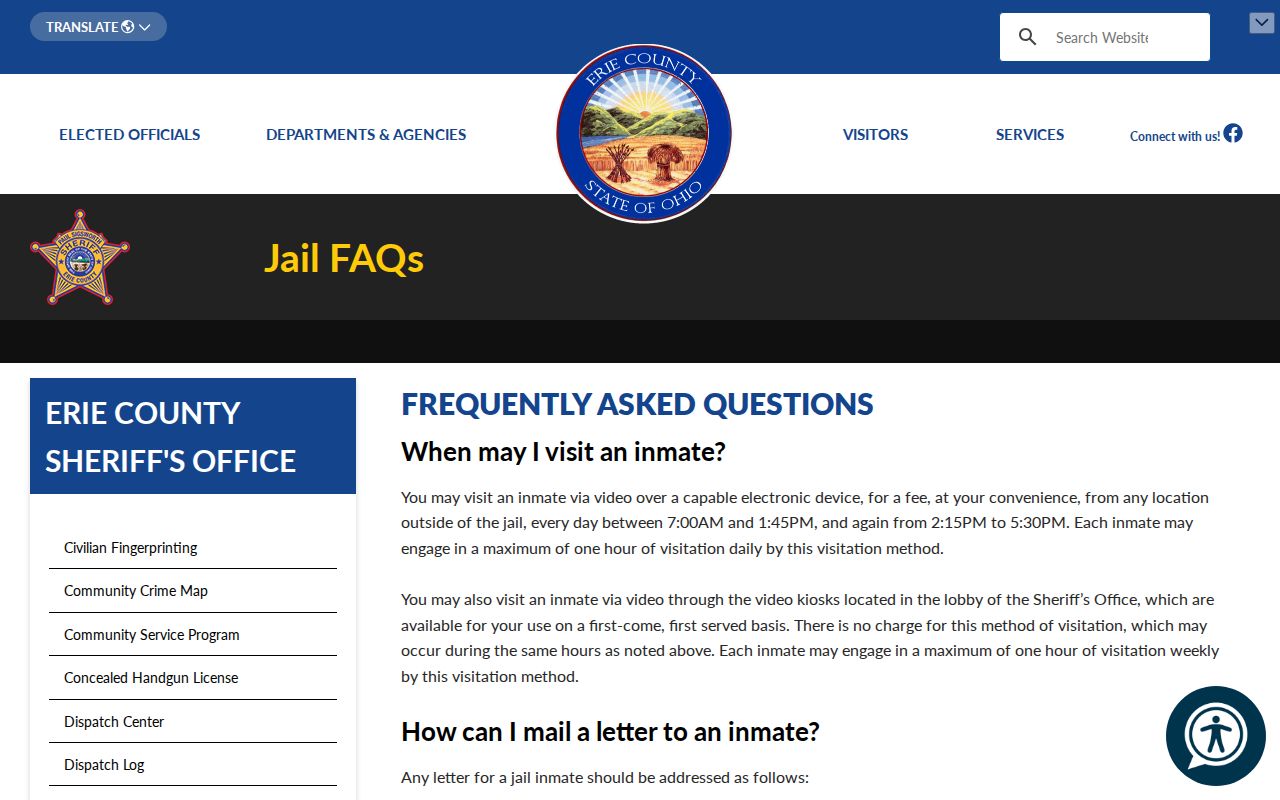
The captured page supports the facility address and the local bond and transferred-property rules used when tracing an Erie County Jail release.