
Erie 72-Hour Releases Are Unpublished
No official Erie County page offers a selectable 72-hour window or an archive of people released over three days. The Sheriff links the JDS New Inmate Roster. That report is a snapshot of current county custody. It includes a Release Date field, but the label does not change the report into a release feed. Its run time says when the page was produced, not how often it refreshes or how long any completed row stays online.
A missing entry therefore cannot populate a reliable three-day list. Roster removal can follow a community release, an agency transfer, movement to ODRC, or a data update. The Sheriff’s release sheet provides the actual date and time, release authority, and disposition or destination. The relevant court docket provides the order or case event behind the change.
Reconstruct Erie County Three-Day Releases
A sound 72-hour review starts by fixing the exact time window. Write down the start and end dates, including time of day. Save the current roster run time and any identifiers already known. Then request the booking and release records for that span from the Erie County Sheriff. A broad demand for “everyone recently released” can be harder to process than a request tied to three dates and a named record series.
- Define the three-day period and note whether a weekend or holiday falls inside it.
- Check the current roster for people still in Erie County Jail and capture the report run time.
- Ask the Sheriff for public booking and release entries with actual release date, time, authority, and destination in that period.
- Use the roster’s Court field to match each event with Common Pleas, Erie County Municipal, Sandusky Municipal, or another named court.
- Use Ohio VINE for participating custody events and ODRC only for people who entered state prison or state supervision.
Sheriff Paul Sigsworth’s office is at 2800 Columbus Avenue, Sandusky, and the Jail Division number is 419-627-7569. Under ORC 149.43, ask for the public portions and accept lawful redactions. Electronic delivery is sensible. The Sheriff policy says ordinary records carry no fee except where otherwise noted, though media or postage costs may apply.
Erie Three-Day Release Fields
The online roster and the historical release record serve different purposes. Roster fields help identify the person, booking, charge, and court. A three-day release history needs the final event fields that may not be visible online. Ask for the smallest set that answers the question. Sensitive medical, personal, security, and juvenile data do not belong in the request.
| Field | Use in a 72-hour review |
|---|---|
| Jail ID and name | Links the row to the correct Erie booking and reduces name confusion. |
| Book date and time | Separates repeated custody episodes and frames the requested record. |
| Release date and time | Places the completed custody change inside or outside the three-day period. |
| Release authority | Identifies the court order, sentence rule, bond, or other legal basis. |
| Disposition or destination | Distinguishes return to the community from transfer to another agency. |
| Charge and court | Routes verification to the correct local docket. |
| Arresting agency | Helps identify the originating case and report source. |
A populated Release Date on a roster row can be useful evidence. It is still necessary to see whether it was scheduled or completed. A blank field means only that no date appears in that snapshot. Neither result alone establishes a three-day release list.
Erie Weekend Release Reconciliation
The value of a three-day review is reconciliation, not a special Erie feed. A Friday court order may be followed by later jail processing. A weekend commitment may end at an hour set by policy. The online docket may post after the custody change, and the roster may be regenerated before a researcher sees the old row. Comparing dated records prevents those separate update cycles from being treated as contradictions.
Erie County Municipal Court warns that online information can lag judicial action by at least 24 hours. Common Pleas felony records use the Clerk’s separate public system. Sandusky Municipal Court also appears in roster entries and needs its own docket path. The Court field matters. It tells which office can verify a bond order, dismissal, time-served entry, sentencing event, or transport order.
The Erie County Municipal Court search page explains the delay and the need to seek verified information from the court.
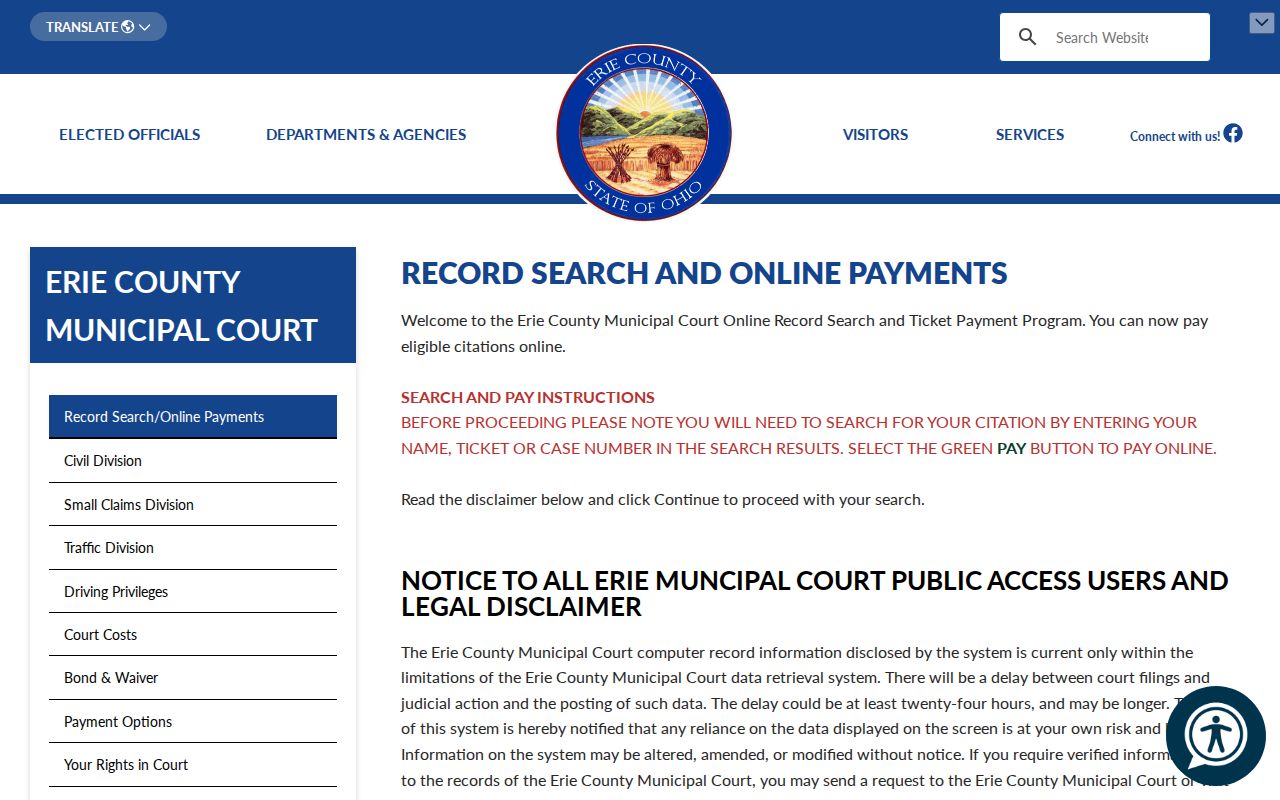
The court portal supplies case context across the three-day period. The Sheriff release sheet remains the best record of the custody handoff itself.
Note: A weekend or holiday may widen the gap between a jail event and a visible court update, so record both source times.
Erie Release Date Column Explained
Erie’s roster is a plain print-style report with separate custody rows and embedded photos. Research found a Release Date column, yet active rows had blank values. No official text promises a 24-hour, 48-hour, or 72-hour retention period for a populated row. This is the central Erie data quirk: a useful field appears inside a report that is not designed or labeled as a recent-release archive.
The underlying record and the web display also have different lifespans. The Sheriff maintains a formal retention schedule under Ohio law. If an older booking sheet, photograph, release checklist, or jail register is needed, name that series and ask whether it remains. Do not infer destruction just because the roster has changed. Likewise, do not ask the office to recreate a web row that no longer exists.
- Report run time
- The generation time for one roster snapshot.
- Refresh cadence
- The update interval, which Erie does not promise on the roster page.
- Display retention
- How long a row stays online, also not stated by the county.
- Records retention
- The approved period for a named underlying record series.
Match Erie Releases to Custody
A three-day list becomes misleading when county and state data are combined without labels. The Erie roster covers adult county-jail custody. Juvenile detention records follow court confidentiality rules and are not part of that adult public report. The ODRC search covers Ohio prison incarceration, release, and APA supervision. BOP and ICE tools answer still different federal questions.
| Custody path | Three-day verification source |
|---|---|
| Erie County Jail | Sheriff release record plus the issuing local court docket. |
| Ohio state prison | ODRC Offender Search and the sentencing court entry. |
| Participating VINE agency | Ohio VINELink event followed by the agency’s record. |
| Federal transfer | Erie transfer documentation plus the applicable federal docket or locator. |
| Juvenile placement | Official Juvenile Court or facility route, subject to confidentiality. |
ODRC’s Released filter should be used only when state imprisonment is plausible. APA Supervision covers parole, post-release control, and related state supervision. It cannot fill gaps for a short county-jail stay. VINE can corroborate a reported change, but “not found” is not proof that a release occurred.
Erie Scheduled and Actual Release
A three-day OVI commitment in Erie County is measured as 72 actual hours from booking. That local rule sounds like the page’s topic, but it is not a 72-hour list. It is a sentence timing instruction for one commitment type. Other commitments default to a 5:00 a.m. release on the scheduled date when the authorizing document states no time.
Actual exit can differ from a schedule. Jail staff verify identity, complete release paperwork, handle funds and property, and check for active holds or warrants. Another agency may take custody. A transfer row should not be described as a community release. Ask for the final release time and destination, especially when the only online clue is a projected date.
The narrower 24-Hour Releases process is better for a same-day event. It emphasizes immediate Jail Division contact. The three-day process is designed to reconcile records that posted on different schedules.
Request Erie Three-Day Release Records
A purpose-neutral request can ask for public booking and release entries for a defined date range. Specify Erie County Jail, the start and end date, and the fields needed: name, Jail ID, booking date and time, release date and time, authority, and disposition or destination. Ask for electronic records and advance notice of any permitted charge. Also ask the office to redact exempt data rather than withhold an otherwise public record in full.
For one person, include a case number or Jail ID if already known. Then obtain the matching journal entry from the named court. For a broad three-day reconciliation, expect that lawful redactions may be needed. The Sheriff is not required to create a new 72-hour report if it does not exist, but existing public records can be requested in the form the office keeps them.
The complete named-person search path and release-record field inventory are available on the Erie County released inmates home page. That route is more precise when the goal is to verify one custody change rather than reconstruct the whole period.