
Erie County Parole and Probation
Probation in Erie County is usually called community control. It is imposed by a court instead of, or sometimes after, a jail term. The Erie County Common Pleas Adult Probation Department supervises community control ordered in felony cases. Erie County Municipal Court has a separate probation department for cases within that court. A sentencing journal entry is the best public proof because it identifies the court order, conditions, and term. The probation office can answer process questions, but it is not a public name-search portal and may not release protected case-management notes.
Parole belongs to the Ohio prison system. The Ohio Department of Rehabilitation and Correction Adult Parole Authority, or APA, supervises parole, post-release control, and assigned judicial-release cases. Parole is conditional release for an eligible prison sentence after a Parole Board decision. Post-release control is a statutory period that can follow a prison term. Judicial release starts with an order from the sentencing court. None of these should be called county probation merely because the person now lives in Erie County.
| Status | Who orders it | Best public verification |
|---|---|---|
| Community control | Common Pleas or Municipal Court | Court sentencing journal and the correct local probation office |
| Parole | Ohio Parole Board under state law | ODRC offender detail, release detail, and Board outcome |
| Post-release control | Ohio law and the sentencing entry | ODRC APA Supervision status plus the court journal |
| Final discharge | The supervising authority | Supervision end data or a formal termination entry |
- Community control
- A court-ordered form of local supervision commonly called probation.
- APA supervision
- State supervision by the Adult Parole Authority after or near an ODRC prison term.
- Absconder
- A person alleged to have left supervision without permission or stopped reporting.
- Discharge
- The formal end of custody or supervision, not merely release from a building.
Verify Erie County Post-Release Supervision
Start with the legal source that fits the case. A former Erie County Jail detainee may have bonded out with no probation order yet. Someone sentenced to community control should have that status in a local court journal. A person who entered an Ohio prison may appear in the ODRC Offender Search under APA Supervision. The search also has separate Released and Violators at Large filters. A Released result does not by itself mean supervision ended, while an APA Supervision result does not necessarily mean parole.
- Identify the court and custody path from the Erie jail record, case number, or sentencing entry.
- For Common Pleas community control, review the Common Pleas case docket and locate the sentencing journal entry.
- For Municipal Court probation, use that court's record and contact its probation department when the public docket needs clarification.
- For parole, post-release control, or judicial release from prison, search ODRC by name or offender number and select the matching status.
- Compare the supervision start and end information with the court entry. Confirm a close match by offender number and case details.
- If a warrant or Violators at Large result appears, verify it with the authority that issued it before reaching a conclusion.
The official ODRC search form shows the status filters used for this distinction.
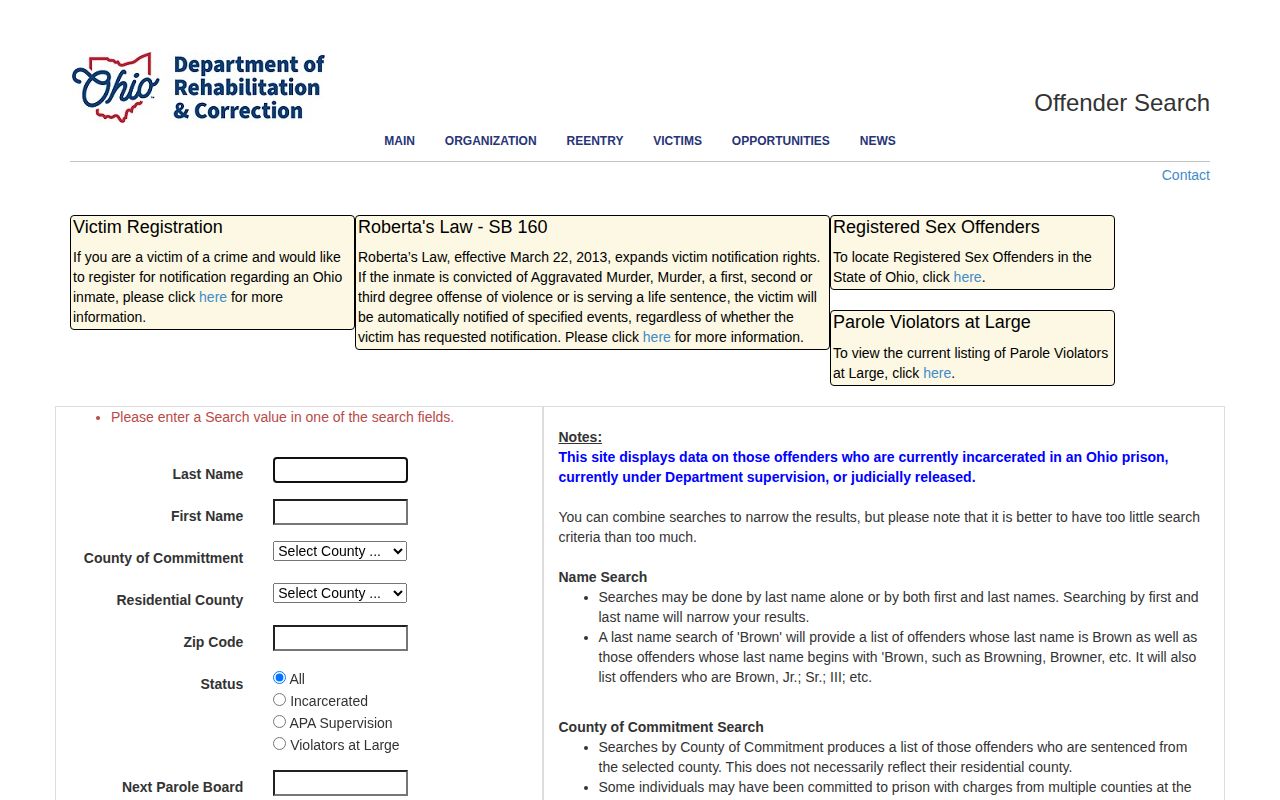
The form separates Released, APA Supervision, and Violators at Large, so the chosen filter changes the question being asked. The broader search and release-record path is covered on the Erie County released inmates home page.
Important: Leaving the Erie County jail roster is not proof of probation, parole, or freedom from another agency hold.
Erie County Probation Offices
Local probation is divided by court. Erie County Adult Probation is part of the General Division of Common Pleas Court. Official material describes presentence work, community-control supervision, pretrial bond-condition monitoring, electronic monitoring or house arrest, a three-phase intensive-supervision program, field address checks, and a low-risk reporting kiosk. These functions are local. They do not make the office an arm of ODRC or a public person locator.
Municipal probation is separate. A person whose case is in Erie County Municipal Court should not be routed to Common Pleas merely because both offices use the word probation. The docket's court name is the key. If an appointment was missed, the Municipal Court department instructs the supervised person to contact the office and request a new date. Address or phone changes must be sent in writing.
Erie County Adult Probation
503 West Washington Street
Sandusky, OH 44870
419-627-7755
Monday through Friday, 8:00 a.m. to 4:00 p.m.
Municipal Court Probation
150 West Mason Road
Milan, OH 44846
419-499-4689
The Erie County Adult Probation page documents the local programs and contact channel.
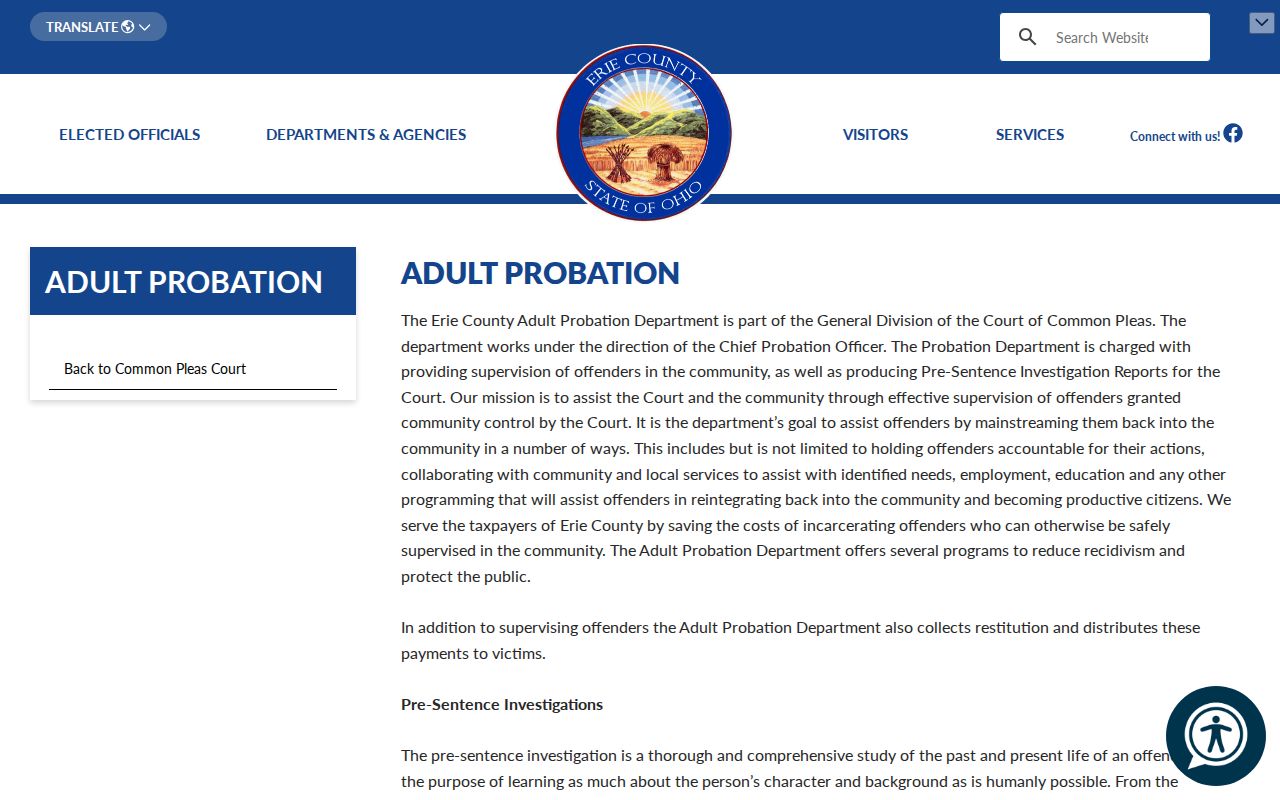
The county page helps route a Common Pleas matter, while the journal entry remains the proof of the actual order.
Erie County Warrants and Absconders
Two public channels address different kinds of unresolved authority. The Erie County Sheriff warrant list concerns warrants routed through the county system. ODRC uses Violators at Large for people alleged to have absconded from APA supervision under Ohio law. A name on one list does not place the same person on the other. Match identifying and case facts, then confirm with the issuing agency.
A warrant or detainer can also affect release. Erie County Jail policy requires staff to check state and national law-enforcement systems and local warrant data before a physical exit. Thus, a scheduled release from one matter can become continued detention or an agency transfer. That is why neither an expected release date nor a missing roster row is enough to state that someone entered the community.
The ODRC parole violators-at-large list shows the state supervision channel.
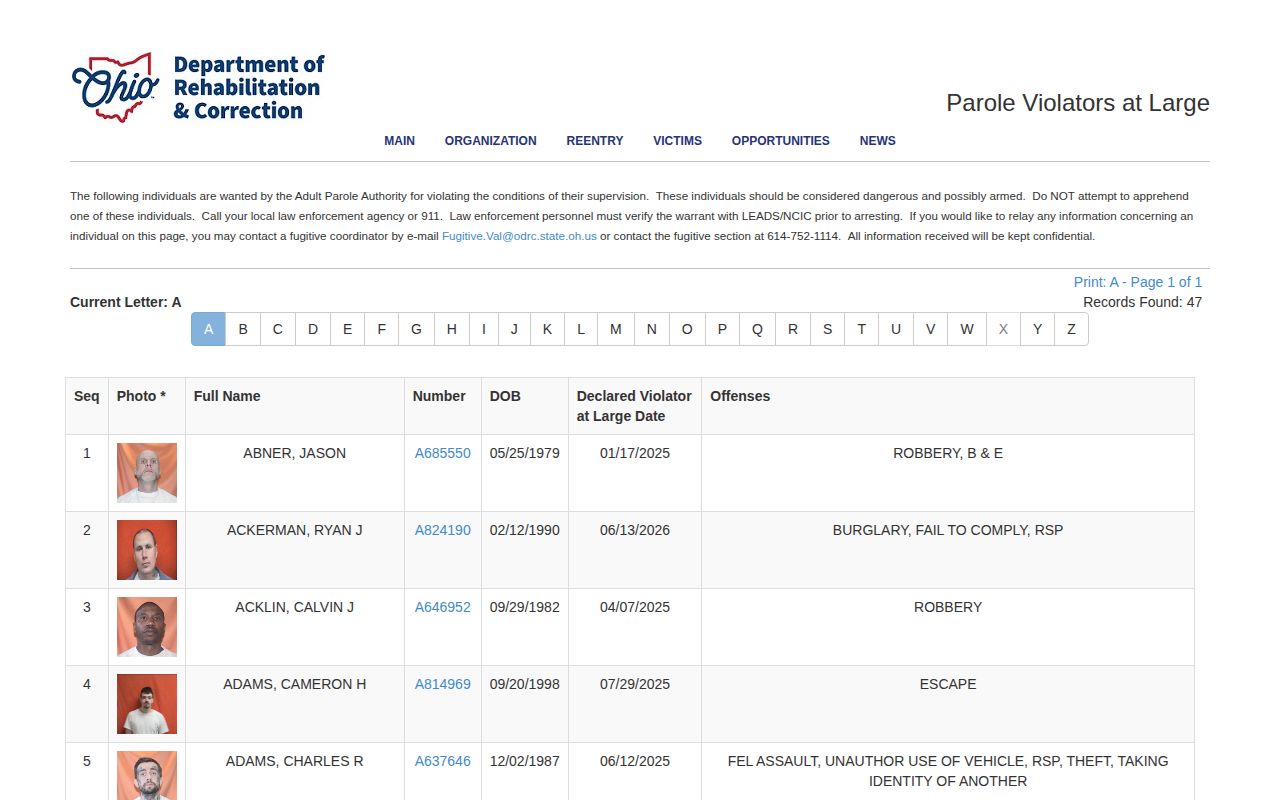
Use that state list only for APA status. Local warrants still require the separate Erie County check.
Note: A warrant entry or Violators at Large status should be verified with the named authority because public displays can change.
Erie County Release Documentation
Erie's jail manual gives another reason to keep custody release separate from supervision. Staff must identify the person, complete the booking-and-release checklist, check holds and warrants, and document the release route. Property and funds are handled as part of that process. A release to another agency is recorded differently from a physical release to the community. Those records describe what happened at the jail door, not whether a court or APA term continues afterward.
If a release record contains an error, a precise request to the Sheriff should identify the Jail ID, booking date, and related court entry. A third-party copy cannot amend the originating jail file. Ask for the booking/release sheet, actual release time, authority, and destination. The court journal or ODRC record then supplies the supervision side of the account.
Erie County Supervision Conditions
Conditions depend on the actual order. Local community control may include reporting, field checks, treatment, community service, electronic monitoring, or other terms imposed by the court. APA terms come from the state supervision authority and the applicable release decision. A general office description cannot establish one person's conditions. Read the journal entry, release decision, and official supervision record instead.
Transitional Control adds a separate category. ODRC defines it as transfer of an eligible person, for up to 180 days before prison expiration or parole, to close community monitoring, a halfway house, or electronic monitoring under ORC 2967.26. An offender detail may show “TC/TT Sentence Expiration,” which is the projected release date from that halfway-house setting. Being outside a prison fence does not necessarily equal final discharge.
Erie County also documents a Community Service Program for certain nonviolent jail inmates or probationers. Work for a public subdivision or nonprofit may receive credit toward remaining jail time or court costs or restitution. The official page gives no universal conversion formula. Any effect on a release date must be checked in the court and jail records.
Erie County Parole Hearing Records
A hearing date is not a release date. ODRC's search accepts a Next Parole Board Hearing Date in YYYYMM form. For a future date, the agency says review may take place about two months before the displayed month so the hearing and decision can occur first. A past date can identify the latest hearing rather than a coming one.
Possible results include grant, denial, or continuance to a later date. A grant authorizes parole under the decision but does not prove that the person left prison that day. Release processing, holds, and later Board action can still matter. When the detail page does not settle the result, request the named decision sheet or applicable minutes from ODRC and compare it with the release detail and supervision start date.
Erie County Supervision Discharge
Supervision ends through a formal act, not by the passage of an expected date alone. For county community control, look for a court entry terminating or completing the order. For APA supervision, review ODRC status and supervision end information. A person may have finished one term while another court order remains active, so match the case number and authority.
Ohio public-record rules do not make the whole probation or parole case file open. ORC 149.43 limits access to some supervision proceeding records, while ORC 5120.21 permits specified ODRC identity, conviction, photograph, incarceration-place, and supervision-status information. Request narrow fields. A final discharge record is stronger evidence than an old status screen.
Note: Verify the end of supervision through the court or ODRC record that had authority over the specific term.